Custom Packaging for Small Businesses UK: How to Choose, Budget & Order
Custom packaging for small businesses can improve product fit, create more consistent presentation and make repeat packing easier. In the UK, however, a poorly planned order can also tie up cash, occupy…

Custom packaging for small businesses can improve product fit, create more consistent presentation and make repeat packing easier. In the UK, however, a poorly planned order can also tie up cash, occupy valuable storage space and leave a business with surplus stock.
Treat packaging as an operating decision first and a branding decision second. Start with the packed product, sales route, realistic order quantity and budget. Then choose the structure, material, print and finish that genuinely earn their place.
Quick answer: what is the best way to buy custom packaging as a small business?
For most small businesses, the best first order uses the simplest specification that fits the product properly, suits its normal route to the customer, carries the required branding and avoids unnecessary pressure on cash flow or storage. Compare quotations against the same specification, check dimensions and artwork carefully, and increase order quantities only after the packaging proves itself in everyday use.
Start with the packaging job, not the box style
A useful packaging brief explains what the pack must do before it describes how it should look.
A candle displayed in a shop, a skincare bottle travelling through an ecommerce network and a folded garment handed over in a boutique can require very different structures, even if each business wants attractive branded packaging.
| Business situation | Practical starting point | Main consideration |
|---|---|---|
| Testing a new product | Suitable stock packaging with simple branding | Avoid committing too much cash or storage space before demand becomes clear |
| Regular ecommerce orders | Made-to-size mailer or shipping format | Product fit, protection, packing speed and finished parcel size |
| Retail product | Folding carton or another suitable product box | Shelf presentation, required information and efficient use of space |
| Multi-item or movement-sensitive product | Outer box with a suitable insert or divider | Product positioning, protection and packing sequence |
| Presentation-led product | Higher-specification presentation format where commercially worthwhile | Balance customer experience against cost, assembly and storage |
That table gives you a starting point rather than a complete specification. Product dimensions, weight, fragility, handling and regulatory requirements can all change the right choice.
How to choose custom packaging for small businesses
Measure the product in the form you will actually pack it
Do not begin by guessing the outside size of a box.
Measure the product at its maximum length, width and depth in the orientation you intend to use. Include caps, pumps, cables, booklets, wrapping, inserts and other components that change the finished arrangement.
Keep product dimensions, internal box dimensions and external box dimensions separate. Vertex Packaging’s dedicated guide on how to measure a box correctly explains those measurements in more detail.
A close fit can reduce unnecessary internal space and uncontrolled movement, but tighter does not automatically mean better. Staff still need enough room to load the product without forcing it, while customers need to remove it easily. Fragile or irregular products may require controlled clearance, cushioning or internal support.
Define the route from packing bench to customer
Where does the product go after somebody packs it?
Retail packaging may place greater emphasis on product information, shelf presentation, stacking and opening. Ecommerce packaging also needs to cope with handling, closure, movement during transit and the dimensions of the finished parcel. Gift packaging may justify greater attention to presentation and the opening sequence.
Write down that route before choosing the material or decorative finish. Doing so helps prevent an attractive pack from creating problems during storage, packing or delivery.
Choose the structure before decorative finishes
Box construction affects much more than appearance.
The structure influences assembly, filling, closure, product access, usable printed panels and storage. A folding carton, corrugated mailer and rigid presentation box perform different jobs.
Before choosing one, ask:
- How will staff assemble and fill it?
- Does it need tape, a label or another closure?
- Could the product move inside?
- How much space will unused packaging occupy?
- Can the customer open it easily?
- Which branding panels remain visible after assembly?
- Does the structure suit the product’s normal handling route?
Vertex Packaging’s packaging box styles guidance follows the same product-first principle. Structure changes how a box opens, closes, assembles, stores and works around the packed item.
Once you know the structure works, decide whether additional finishing creates enough commercial value to justify the extra cost or complexity.
Choose the material for the job
“Cardboard” is too broad to work as a useful packaging specification.
Paperboard, corrugated board and rigid board have different structural behaviour. You should not treat Kraft as one universal grade or performance specification either.
Choose the material according to the product, structure, packed weight, handling requirements and desired surface appearance. Vertex Packaging also recommends comparing packaging materials through characteristics such as stiffness, weight, surface character and folding behaviour after you understand the practical requirements.
Ask the supplier which material they recommend and why it suits the application.
If environmental performance matters, ask about the exact construction, coatings and laminations rather than accepting a broad claim such as “eco-friendly”. A material name alone cannot tell you everything about the complete pack or its end-of-life options.
Finalise artwork after you confirm the structural layout
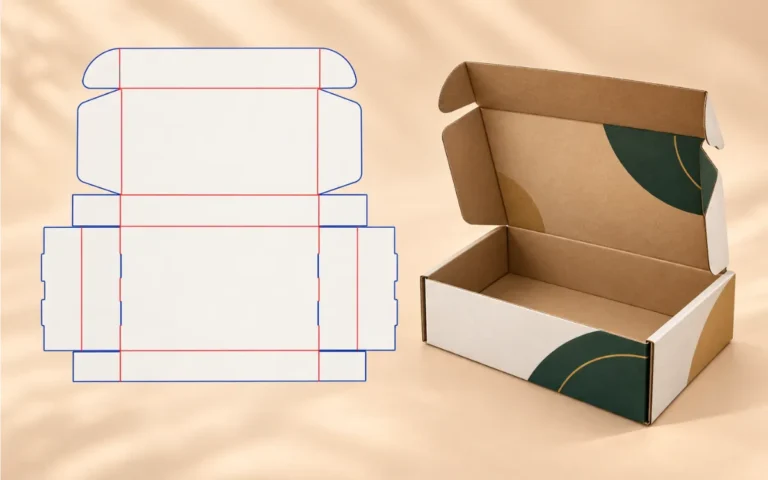
Build the artwork around the confirmed structural layout or dieline.
Folds, glue areas, closures and panel orientation can affect where you place a logo, barcode, ingredients, instructions or other information. Creating final artwork around an assumed template can cause unnecessary redesign work later.
Keep a first-order print brief disciplined. Decide which information must appear, which panel customers see first and which brand elements require consistent reproduction.
You do not necessarily need finished artwork before making an initial enquiry. Vertex Packaging’s current quotation guidance says businesses can provide the packaging information they already have, and the site currently lists free design support.
Businesses looking specifically at printed formats can also explore the custom printed boxes category once they understand the basic structure and size requirements.
How to budget for custom packaging without guessing a unit price
There is no responsible single answer to “how much does custom packaging cost?” without knowing the specification.
Dimensions, order quantity, structure, material, print coverage, finishing and production complexity can all influence a quotation. Small businesses should therefore assess custom packaging as a complete system rather than focus only on the headline box price.
| Cost area | What to check | Why it matters |
|---|---|---|
| Primary pack | Box, carton, pouch or other direct pack | This creates the obvious unit cost, but not the entire packaging budget |
| Internal protection | Insert, divider, tissue or other protective component | Poor product fit can require extra material or allow unwanted movement |
| Print and finish | Colours, print coverage, coatings and decorative effects | Visual choices can increase production cost and complexity |
| Setup or sampling | Structural work, tooling or samples where applicable | Ask exactly what the quotation covers |
| Packing labour | Assembly, inserting and sealing time | A cheaper unit can cost more to use if packing takes longer |
| Storage | Space for flat or assembled packaging stock | Larger orders can create a stockholding problem |
| Delivery effect | Finished packed dimensions and weight | Packaging can influence fulfilment and carrier costs |
| Change risk | Stock left after an artwork or product change | Larger first runs increase exposure to obsolete stock |
A useful internal calculation is:
Packaging cost per sale = packaging components + packing time + storage impact + delivery impact + expected wastage
You do not need a complicated accounting model. The calculation simply prevents a low quoted unit price from hiding costs elsewhere in the operation.
Treat MOQ as a cash-flow and stock decision
MOQ means minimum order quantity: the smallest production quantity a supplier accepts for a particular packaging specification.
No universal number defines a “low MOQ”. The actual quantity depends on the product, structure, production method and supplier.
Lower quantities can make sense for launches, seasonal lines and early tests because they limit cash and stock exposure. A larger run may sometimes reduce the unit price, but buying more creates value only when the business can use that stock before the product, artwork or demand changes.
If you want to understand volume breaks, request quotations for several realistic quantities while keeping the rest of the specification unchanged.
Compare quotations like for like
Two packaging quotations do not offer a fair comparison when the suppliers quote different specifications.
Give each supplier the same brief. Then compare:
- dimensions;
- whether the supplier quotes internal or external dimensions;
- structure;
- material and grade where relevant;
- order quantity;
- print coverage;
- finishes;
- inserts or dividers;
- sampling or proofing;
- delivery terms;
- setup costs or one-off work.
If one quotation comes in substantially lower, identify the specification difference before assuming it offers better value.
When should a small business move from stock packaging to custom packaging?
Stock packaging can make more sense while demand remains uncertain, the product may change soon or the business wants to launch without tying up much cash in packaging inventory.
A plain box, mailer or bag can still carry branding through an appropriate label, sticker, sleeve, card or printed tape.
Custom packaging becomes more useful when staff pack the same products repeatedly, standard sizes leave unnecessary space, packing lacks consistency, the product needs specific protection or a dedicated branded presentation creates enough commercial value.
The decision does not have to be all or nothing.
A business might keep a standard outer shipping carton while customising the retail packaging inside. Another might begin with a stock mailer and branded insert, then move to a made-to-size printed mailer once order patterns become predictable.
What information should you send for a custom packaging quote?
A supplier can prepare a more useful quotation when your brief contains operational information rather than simply asking for “a branded box”.
Prepare the following:
- product type;
- product dimensions and measurement unit;
- approximate packed weight where relevant;
- required quantity;
- intended sales and delivery route;
- preferred packaging style, if already known;
- insert or protection requirements;
- artwork status and logo files;
- required printed information;
- finish or presentation preferences;
- a photograph, sample or reference image where useful;
- required delivery date if the project has a fixed deadline.
Vertex Packaging’s live quote form currently asks for quantity, length, width, depth, measurement unit, product type, inside and outside colour requirements, project details and an optional artwork or reference upload.
Its accompanying guidance also asks businesses to explain product size and weight, intended use, quantity and any known printing or finishing requirements.
You do not need to know every technical packaging term before approaching a supplier. You do need to describe the product clearly and explain what the packaging must accomplish.
If you have already gathered those details, you can request a custom packaging quote and provide the available information directly.
What should you approve before placing the order?
Check the physical specification as carefully as the printed artwork.
Before production, confirm:
- product dimensions;
- finished packaging dimensions;
- whether the supplier uses internal or external dimensions;
- material and structure;
- order quantity;
- insert or divider arrangement;
- artwork version and spelling;
- logo position and panel orientation;
- colour references and print coverage;
- agreed finishes;
- closure and assembly method;
- sample or prototype details where applicable;
- delivery information and any agreed deadline.
Keep the final specification with your purchase records.
Repeat orders become much easier when everybody refers to the same dimensions, structure, material and artwork version instead of relying on an old email or memory.
Common small-business packaging mistakes that cost more later
Ordering a large first run before proving the pack
A lower unit price does not help if the product changes, demand falls below expectations or staff discover that the packaging takes too long to assemble.
Designing artwork before the dieline is final
Artwork created around an assumed layout often needs further work once the supplier confirms folds, closures and printable panels.
Choosing finishes before solving product fit
Foiling, coatings and other decorative details cannot rescue packaging that wastes space, makes loading difficult or uses the wrong structure.
Comparing only the box price
Packing time, inserts, storage, delivery dimensions and unused inventory can all change the real cost of a packaging decision.
Treating every board option as interchangeable
Material construction can affect rigidity, folding, print surface, weight and the way the finished structure performs.
Making environmental claims without checking the finished construction
Do not call a complete pack recyclable, biodegradable, compostable, plastic-free or environmentally preferable simply because one component sounds environmentally friendly.
Ask the supplier for information about the complete construction and use only claims that reliable evidence can support.
A short UK packaging compliance check for growing businesses
Packaging purchasing and packaging compliance cover different areas, but they can begin to overlap as a business grows.
Current GOV.UK guidance says all businesses must check whether they count as a “producer of packaging” under extended producer responsibility for packaging.
For 2026 packaging data, an organisation has EPR obligations when it carries out a relevant packaging activity, operates as a UK-established organisation, supplied or imported more than 25 tonnes of packaging during the previous year and recorded annual worldwide turnover of at least £1 million. GOV.UK sets different obligations for small and large producers.
GOV.UK also says businesses should keep packaging to the minimum weight and volume necessary to maintain product safety and hygiene. That gives right-sizing a regulatory context as well as a commercial one.
Do not assume the everyday label “small business” automatically determines your position under the rules. Check the latest official guidance against your turnover, packaging tonnage and role in the supply chain.
Frequently asked questions about custom packaging for small businesses
Is custom packaging worth it for a small business?
It can make sense when it solves a genuine problem such as poor product fit, inconsistent packing, excessive movement, inefficient use of space or the need for a dedicated branded presentation.
Stock packaging may remain the better choice when it already performs well and demand remains uncertain.
How much does custom packaging cost in the UK?
No universal price applies because size, quantity, material, structure, print, finish, inserts and production requirements all influence quotations.
Give suppliers the same brief and compare exactly what each price covers.
What does low MOQ mean in packaging?
Low MOQ describes a comparatively small minimum production quantity for a particular packaging job.
“Low” does not represent a standard industry number. Ask the supplier for the minimum quantity that applies to the exact structure and specification you want.
Can I request custom packaging before my artwork is finished?
Yes. You can start an initial enquiry with product measurements, quantity, intended use and references for the packaging direction you want.
Develop the final printed artwork around the confirmed structure or dieline. Vertex Packaging currently allows businesses to request quotations before they have finished artwork and lists free design support.
Should I order a sample before a larger production run?
A sample can help when you need to check product fit, opening, loading, product position or presentation before committing to a larger order.
Ask what type of sample or proof the supplier offers and what it allows you to assess. A plain structural sample and a finished printed sample may answer different questions.
Build a packaging specification that can grow with the business
Good custom packaging for small businesses does not have to become complicated. It needs to fit the product, suit the sales route, remain practical to pack and store, and make financial sense at the quantity the business can genuinely use.
Start with accurate product measurements and a clear brief. Compare structures and materials before adding decorative extras. Assess the complete packaging cost rather than chasing the lowest unit price. Then compare quotations against the same specification and keep the final details for future orders.
Businesses ready to compare available formats can explore the Vertex Packaging custom packaging range.
Once you have product dimensions, quantity, intended use and any available artwork or references, the Get a Quote page provides the next practical step.
The current Vertex Packaging site lists free design support, low-MOQ options and free UK delivery. Confirm the exact quantity, specification, pricing and commercial terms for your individual project rather than assuming that one set of conditions applies to every order.
Planning Your Next Postal Packaging Project?
Get practical support with box style, size, material, print and finishing options for your next postal packaging order.