
Description
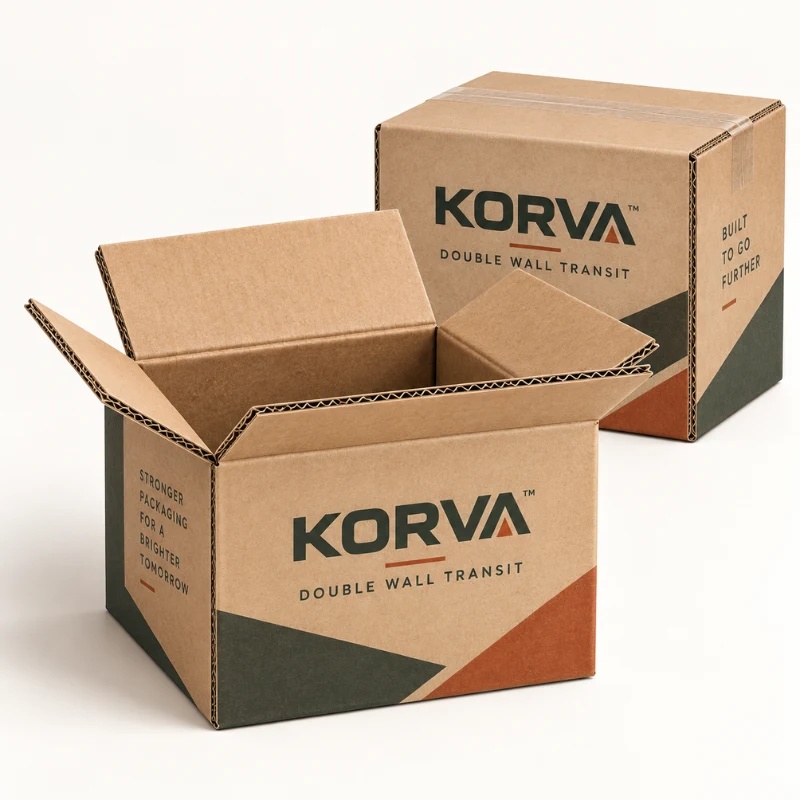
Double Wall Shipping Boxes are corrugated transit cartons made with two fluted layers between three liner sheets. This five-layer board gives greater rigidity than single wall construction, so it suits heavier, fragile, bulky or high-value goods that need more support during storage, handling and delivery. The final specification should still match the product and journey.
Why Double Wall Shipping Boxes Suit More Demanding UK Deliveries
Shipping conditions can put pressure on every part of a carton. Weight pushes against the base, stacked parcels load the side walls, and repeated handling affects corners and edges. For that reason, a stronger board structure can matter when a single wall case no longer provides enough support.
Double wall corrugated board adds a second fluted medium. The extra layer increases board depth and stiffness. Industry sources describe double wall board as two layers of fluting between three liners and commonly use it for heavy, fragile, bulky or high-value products.
However, wall count does not tell the whole story. Box dimensions, paper grade, flute combination, product weight, internal support and supply-chain conditions all influence performance. A well-specified double wall carton therefore starts with the packed product rather than a generic strength label.
Practical Benefits of a Two-Flute Corrugated Structure
The second corrugated layer creates a more substantial board for demanding shipping and storage.
- Greater structural rigidity: two fluted layers help the board resist bending and compression better than comparable single wall construction.
- Improved support for heavier contents: a stronger case can manage products that place more stress on the base and side panels.
- Extra cushioning depth: the additional corrugated layer puts more material between the contents and external contact.
- Better stacking suitability: the stronger wall can help cartons retain shape when the grade and case design match the load.
- Custom sizing: made-to-size dimensions can reduce movement and unnecessary void space.
These benefits still depend on correct specification. A compact metal component can create high local loads inside a small box, while a large light product may need stiffness because of its dimensions.
How Double Wall Corrugated Board Is Constructed
A typical double wall sheet has five paper layers: an outer liner, a fluted medium, a centre liner, a second fluted medium and an inner liner. This construction is also commonly described as five-ply corrugated board.
Manufacturers can combine different flute profiles in one board. Common double wall combinations include BC and EB flutes, although availability and suitability depend on the job. Different profiles affect board depth, cushioning and surface characteristics.
Paper grades matter too. Therefore, two boxes described simply as “double wall” may not perform identically. Buyers should consider the complete board grade, finished dimensions and case style rather than treating every double wall carton as interchangeable.
Brown kraft-style outer liners are common for transit packaging. White outer liners can provide a cleaner base for graphics where presentation matters.
Custom Sizes, Case Styles and Internal Fit
Double Wall Shipping Boxes can be produced in dimensions that suit the product, protective material and handling method. Accurate internal measurements help avoid a case that is unnecessarily large or too tight around the contents.
Regular slotted cartons are widely used because they store flat and close with tape. Other corrugated box styles can support different loading methods or flap arrangements. The FEFCO Code provides an internationally used system for identifying common corrugated packaging designs.
Internal protection may include corrugated pads, partitions and die-cut fitments. These components can separate products, protect vulnerable areas or limit movement during transport.
Handles or hand holes may work for selected structures, but only where the board, load and case design support them. Inserts should likewise solve a genuine protection or organisation requirement.
Printing and Finishing Double Wall Cardboard Boxes
Printed double wall boxes can carry logos, handling information, barcodes, product references or brand graphics. The print method should match the corrugated surface, artwork and order requirements.
Flexographic printing often suits straightforward text, logos and spot-colour graphics. Digital printing can support detailed or full-colour artwork on compatible constructions. Lithographic print laminated to corrugated board is another option where higher-detail presentation is required.
CMYK supports process-colour artwork, while Pantone references can help specify spot colours. However, brown and white liners affect colour appearance differently, so the substrate matters during artwork preparation.
Selected constructions can use coatings, laminated surfaces or decorative finishes. For ordinary shipping cartons, though, structural performance and readable print usually matter more.
Custom Postal Boxes provides free design support to help prepare artwork around folds, joins, flaps and visible panels. This can keep important graphics clear of tape lines or closure areas.
Where Double Wall Shipping Packaging Is Most Useful
Double wall cardboard boxes make sense when contents or distribution conditions demand more support than a lighter case. Typical uses include:
- engineering parts, tools and dense trade components;
- automotive parts and replacement assemblies;
- grouped retail products packed into one outer case;
- fragile goods used with suitable cushioning or fitted protection;
- warehouse transfers and palletised distribution;
- equipment and hardware exposed to repeated handling.
The same board is not right for every item. A fragile ceramic product may depend heavily on cushioning, while a dense component may place more emphasis on base strength and secure closure.
Businesses shipping lighter products can compare corrugated boxes with less demanding specifications. Buyers needing other transit formats can review custom shipping boxes across different wall constructions. Cardboard boxes also cover broader packing uses where double wall strength may not be required.
Why Choose Custom Postal Boxes for Double Wall Cartons
In-house manufacturing keeps the agreed dimensions, corrugated specification, structure and print requirements connected with production. This matters because the finished fit and board choice need to work together.
Free design support can help place artwork correctly on the dieline and reduce problems with graphics crossing folds, joins or closures.
After manufacturing, fast and free UK delivery helps move finished packaging into your operation without a separate standard UK delivery charge. The production route still depends on size, quantity, print coverage and structural requirements.
How to Order Custom Double Wall Shipping Boxes
A clear packaging brief makes it easier to quote the right structure and board.
- Describe the contents. Share the product type, packed weight, fragility and vulnerable areas.
- Provide internal dimensions. Give the required length, width and height, including room for cushioning or fitments.
- Confirm the quantity. Order volume can affect the suitable manufacturing and print method.
- Explain the distribution route. Mention stacking, palletisation, courier handling or storage where relevant.
- Choose the box structure. Select a case style that supports loading, closing and handling.
- Set print requirements. Provide logos, colours, handling marks and other artwork details.
- Review the quotation and artwork. Check dimensions, board specification and print position.
- Approve production. Manufacturing can then proceed before UK delivery.
Frequently Asked Questions
What are Double Wall Shipping Boxes?
Double Wall Shipping Boxes are corrugated cartons made with two fluted layers and three liner sheets. This five-layer structure creates a stiffer board than single wall material. Businesses commonly use it for heavier, fragile, bulky or higher-value goods that need stronger outer packaging.
What is the difference between single wall and double wall boxes?
Single wall board has one fluted layer between two liners, while double wall has two fluted layers between three liners. The extra flute and liner give double wall board greater depth and rigidity. However, the correct choice still depends on weight, dimensions, fragility and transport conditions.
Are double wall boxes suitable for heavy products?
Yes, they can suit heavier products when the board grade, dimensions and case style match the load. There is no universal safe weight for every double wall carton. Product density, stacking, handling and internal protection can all change the demands placed on the box.
Can Double Wall Shipping Boxes be made to custom sizes?
Yes. Custom internal dimensions can be set around the product, cushioning and fitted components. A closer fit can reduce unwanted movement and excess void space. Accurate dimensions also help assess the correct board and case construction before manufacturing.
Can double wall cardboard boxes be custom printed?
Yes. Suitable cartons can carry logos, handling marks, barcodes, product references and other approved artwork. Flexographic, digital or lithographic methods may apply depending on the board, artwork, quantity and finish. Brown and white liners can also produce different visual results.
Can dividers or inserts be added?
Yes, where the product needs separation, positioning or extra internal support. Corrugated partitions can keep components apart, while die-cut fitments can control movement. The insert should work with the outer box rather than compensate for a carton that is too weak or too large.
Request a Quote for Double Wall Shipping Boxes
Send Custom Postal Boxes your internal dimensions, quantity, packed product details, print requirements and delivery conditions for a quotation. If you are unsure about board grade or internal protection, explain how the goods will be packed, stored and transported so the specification can be reviewed before production.













Reviews
There are no reviews yet.