E Flute vs B Flute vs C Flute: Which Corrugated Board Is Best for Postal Boxes?
For most compact branded postal boxes, E flute is the thinner starting point. B flute gives a deeper single-wall profile when the pack needs more structural margin. C flute goes deeper again…
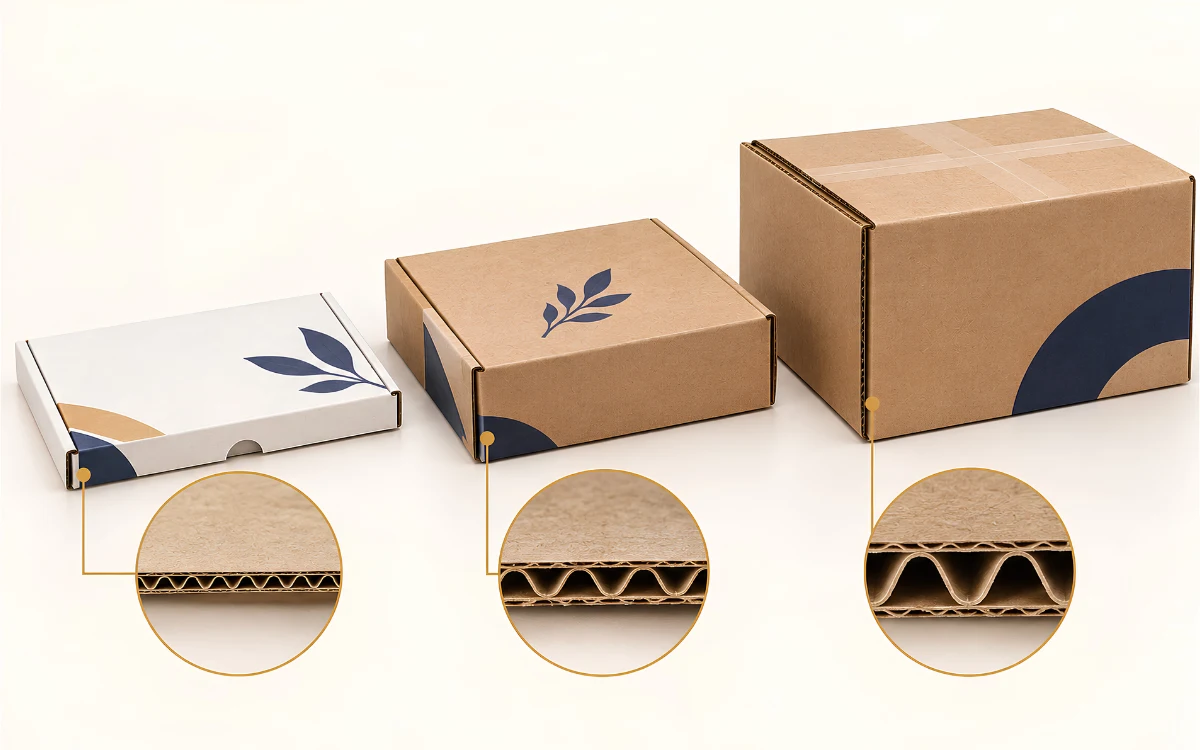
For most compact branded postal boxes, E flute is the thinner starting point. B flute gives a deeper single-wall profile when the pack needs more structural margin. C flute goes deeper again and more often suits larger transit cartons. That is the practical answer to E flute vs B flute. However, the flute letter alone does not tell you how much weight a finished box can carry. The liners, medium, box dimensions, structure and distribution conditions matter too.
E, B and C flute compared at a glance
FEFCO’s corrugated-board production data gives indicative flute heights of about 1.2mm for E flute and 2.4mm for B flute. FEFCO lists C flute at about 3.6mm. Those measurements exclude the facings, so they are flute heights rather than guaranteed finished-board thicknesses. FEFCO also lists about 290 flutes per metre for E, 150 for B and 130 for C.
| Flute | FEFCO indicative flute height* | Flutes per metre | Useful starting point for postal packaging |
|---|---|---|---|
| E flute | 1.2mm | 290 | Compact mailers, smaller ecommerce packs and print-led postal boxes where wall depth matters |
| B flute | 2.4mm | 150 | General postal and shipping boxes needing a deeper single-wall section |
| C flute | 3.6mm | 130 | Larger single-wall transit cartons where extra section depth and cushioning may be useful |
*Flute height excludes the liner facings.
The table compares geometry rather than load ratings. A particular E-flute board grade can outperform a poorly specified B-flute board in a given test. The papers, grammages, moisture condition and box design are all part of the performance specification.
What does “flute” actually mean in corrugated board?
Corrugated board combines flat liner papers with a wave-shaped paper medium called fluting. In single-wall board, one fluted medium sits between two liners. FEFCO describes this three-layer construction as the basic single-wall corrugated structure.
The flute profile changes the height and spacing of the waves. E flute uses a shallow, closely spaced profile. B flute is taller and less densely spaced, while C flute is taller again.
This changes the board’s section depth. It also influences behaviour under flat crushing, edge loading, bending, printing and impact.
It is important to separate the flute from the complete board grade. FEFCO has separate test methods for puncture resistance, flat crush resistance and edgewise crush resistance. It also has a method for box compression. A flute name is therefore not a substitute for a tested board or finished-box specification. You can review the relevant FEFCO testing methods and recommendations.
E flute vs B flute: which is better for postal boxes?
Neither is universally better. E flute is usually the more logical starting point when a postal box must stay compact and fold neatly. It can also suit detailed branding. B flute becomes more attractive when the box needs a deeper corrugated section or more margin against handling demands.
The difference matters most when the same product can physically fit either board.
A small cosmetics set may already have individual retail cartons and need only a tidy ecommerce mailer. In that case, the extra wall depth of B flute may add little. Denser contents or hard corners change the decision. Repeated stacking with other parcels can also justify reviewing B flute.
Do not turn that into a product-weight rule. There is no reliable rule such as “E flute is for products up to X kg”. Any such limit needs the complete board grade, dimensions, box style and handling conditions.
Where E flute makes sense
E flute’s 1.2mm indicative flute height and high flute count create a compact corrugated section. That can be useful for die-cut mailers, subscription packs, beauty products, accessories, books and other relatively compact ecommerce orders.
Its fine flute spacing also makes E flute well suited to packaging where surface appearance matters. The Canadian Corrugated and Containerboard Association describes E flute as a profile used where high print quality is required.
Printing specialists also note that visible “fluting” in direct corrugated print comes from density differences over flute peaks and valleys. The Flexographic Technical Association explains this effect in more detail.
In practice, the liner paper and print process still matter. E flute should not be sold as an automatic guarantee of better graphics.
E flute is also useful where external parcel depth is tight. A deeper board wall consumes more of the available dimensional allowance. That becomes especially relevant for a postal box designed close to a carrier threshold.
Where B flute makes sense
FEFCO lists B flute at about 2.4mm, roughly double the indicative 1.2mm height of E flute.
For general ecommerce dispatch, B flute can be a sensible step when an E-flute mailer feels too light. Box size, product geometry and the handling route should drive that judgement.
Hard edges, larger panels, repeated stacking and a heavier packed product can all justify reviewing a deeper profile.
However, “B flute is stronger than E flute” is still too broad as a technical specification. Strength is not one property. Flat crush, edge crush, puncture, bending and finished-box compression measure different behaviours, and the paper combination changes the result. FEFCO maintains separate test methods precisely because these properties are not interchangeable.
Where does C flute fit?
C flute is a deeper single-wall profile. FEFCO lists an indicative flute height of 3.6mm and about 130 flutes per metre.
For postal packaging, C flute more naturally suits larger shipping cartons than very compact presentation mailers.
The additional section depth can be useful when cushioning or carton rigidity matters more than keeping the wall slim. A larger homeware item or an already-boxed retail product may push the specification towards C flute. Multi-item shipments can do the same, depending on the full board grade and box design.
C flute still accepts print, but a deeper flute profile changes the substrate underneath the liner. If artwork detail is the priority, consider the print method with the board. Do not assume one flute will determine the result.
For products that need more than single wall can provide, the next question may not be “B or C?” at all. Double-wall combinations such as EB or BC use two fluted media with additional liners. They belong to a different performance class.
Why flute height is not the same as finished board thickness
This is one of the easiest corrugated specifications to misread.
FEFCO’s 1.2mm, 2.4mm and 3.6mm values describe indicative flute height with the facings excluded. A finished sheet also contains the inner and outer liners, adhesive and normal manufacturing variation.
A supplier who quotes “E flute 1.2mm” may therefore mean the flute profile, not the measured caliper of the finished board.
Before approving a box, ask what the stated thickness actually represents. It may be flute height, nominal board caliper or an actual measured board specification.
This distinction also explains why web guides disagree. Many pages round E flute to about 1.5mm, B flute to around 3mm and C flute to around 4mm. Those figures can be useful as rough finished-board descriptions. However, they are not the same measurement as FEFCO’s flute-height data.
That difference sounds small until a box has to fit a product closely or remain within a postal depth limit.
Does a thicker flute automatically mean a stronger postal box?
No. Increasing flute height changes the structure, but a finished box is a system rather than a single number.
Performance also depends on the liners, corrugating medium, paper weights and fibre composition. Adhesive bond, flute direction, box dimensions and structural style matter too. Storage humidity, stacking and handling also affect the result.
This is why FEFCO separates tests for board properties from tests for complete corrugated packaging. Edgewise crush resistance measures a property of the board. Box compression testing evaluates the complete container under compression.
For a demanding shipment, a tested board grade or packed-box test is more useful than choosing by flute letter alone.
For buyers, the practical lesson is simple. Use E, B or C flute as the beginning of the specification conversation, not the end.
How flute choice affects postal dimensions
Flute choice can change the external size of a finished box.
If you hold the internal dimensions constant, a deeper board generally increases the outside dimensions. If the external dimensions must stay fixed, deeper walls reduce the usable internal space.
This can matter for Royal Mail formats. A Large Letter, for example, currently has a maximum external depth of 2.5cm. You can check the current limits on the Royal Mail UK sending guidance.
A shallow product may fit comfortably inside an E-flute structure. Change the same design to a deeper profile and some useful internal depth can disappear.
Measure the finished pack; the flute name does not prove postal compliance.
For a Small Parcel or larger courier box, a few extra millimetres may not change the service band. They can still affect product fit, pallet density and remaining void space.
E flute vs B flute for printing: what actually changes?
E flute usually gives the more print-friendly direct corrugated surface because its flute peaks are smaller and more closely spaced. That does not mean B flute cannot carry high-quality branding.
Direct flexographic printing is sensitive to the corrugated surface beneath the liner. The Flexographic Technical Association describes “fluting” as visible density variation between flute peaks and valleys. Board quality, plate technology, pressure and artwork all influence the result.
Digital printing can also work on suitable corrugated substrates.
For higher-detail presentation graphics, converters can laminate a lithographically printed sheet to corrugated board. In that construction, printers produce the artwork on a separate sheet before mounting it to the corrugated substrate. Flute choice is therefore only one part of the visual outcome.
A buyer comparing E flute vs B flute should therefore separate two questions.
What board structure does the product need?
What print process does the artwork need?
Match the flute to the box style, not just the product
The same product can behave differently in two box structures.
A roll-end mailer with locked side walls distributes loads differently from a regular slotted shipping carton closed with tape. Inserts can restrain movement, while dividers can stop several items loading one wall at the same point.
That is why the flute decision should follow the packed arrangement. Start with product dimensions and mass, then account for sharp corners, fragility, internal fitments, stacking and the distribution route.
For compact branded ecommerce packs, the Corrugated Mailer Boxes range is the closest commercial route. Custom Postal Boxes already describes these as fluted, die-cut ecommerce mailers whose board grade should follow packed weight, dimensions and handling.
Buyers comparing the broader material family can use the Corrugated Boxes category. Single Wall Corrugated Boxes are more relevant when the decision concerns one flute between two liners.
Larger transit-led packs belong more naturally with Custom Shipping Boxes, where the specification centres more heavily on shipping, stacking and delivery conditions.
Those pages handle quotation and product intent. This guide helps a buyer reach the board-selection conversation with better information.
A practical E, B or C flute decision framework
Use the following as a starting point rather than a substitute for a board specification.
| Packaging priority | Flute to consider first | Why | What still needs checking |
|---|---|---|---|
| Compact branded mailer | E | Shallow profile and fine flute spacing | Packed weight, box span, print process, transit risk |
| General ecommerce postal box | E or B | Balances compactness against a deeper single-wall structure | Product density, corners, stacking and fit |
| Larger single-wall shipping carton | B or C | Deeper section may suit larger panels and more demanding handling | Board grade, compression requirement and route |
| High-detail direct print | E | Fine flute spacing can support a smoother printing surface | Liner, ink system, press and artwork |
| Fragile or heavy shipment | Do not choose by flute alone | Inserts, complete board grade and box design may dominate | Packed-box testing and possible double wall |
If the choice remains uncertain after this table, the supplier needs more information. It does not mean the buyer should select the thickest flute by default.
Frequently asked questions
What is the main difference between E flute and B flute?
E flute has a finer, shallower profile. FEFCO lists E flute at about 1.2mm and around 290 flutes per metre. B flute is about 2.4mm and 150 flutes per metre. E therefore suits compact corrugated packs particularly well, while B gives a deeper single-wall section. Finished performance still depends on the complete board grade.
Is E flute strong enough for postal boxes?
It can be. Manufacturers widely use E flute for compact corrugated cartons and mailers. However, the flute letter alone cannot establish whether a box is strong enough for a specific shipment. The specification should account for product weight, dimensions, load points, liners, medium, box style, inserts and delivery conditions.
Is B flute stronger than E flute?
Not in every possible sense. B flute has a deeper profile, but “strength” is not one measurement. It can mean edge crush, puncture resistance, flat crush, bending stiffness or finished-box compression. Different paper combinations can also change performance. If protection is important, compare the complete board specification and the test property that matches the real shipping risk.
Is C flute better than B flute for shipping?
C flute can be useful for larger single-wall shipping cartons because its profile is deeper. It is not automatically the better choice. B flute uses a more compact section and may suit many shipping boxes. Box size, product mass, stacking, cushioning needs and board grade should decide between them.
Which flute gives the best print quality?
E flute is generally the strongest starting point of these three when direct-print surface smoothness matters. It has the finest flute spacing. Flute alone does not control print quality, though. Liner quality and the printing method still matter. Litho-lamination can produce detailed graphics on a separate printed sheet mounted to corrugated board.
Does E flute vs B flute change the size of a postal box?
It can. B flute has a deeper indicative profile than E flute. Changing board can therefore alter external dimensions or reduce internal space if the outside dimensions stay fixed. This is especially important near postal size limits. Measure the completed pack rather than assuming the flute designation proves compliance.
When should I move from single wall to double wall corrugated board?
Consider double wall when the packed product or distribution route demands more than an appropriate single-wall specification can provide. Do not make the switch from weight alone. EB and BC combine two flute profiles. The complete grade and box design still need to match the distribution environment.
Specify the board around the packed product
The useful conclusion from E flute vs B flute is not that one flute wins.
E flute favours a compact section and fine flute spacing. B flute gives a deeper single-wall structure. C flute goes deeper again where that geometry is useful.
For a custom postal box, start with the packed product dimensions, approximate weight, fragility, box style and delivery route. Custom Postal Boxes can then use free design support to discuss a suitable flute and structure before production. In-house manufacturing and fast, free UK delivery are available for suitable orders.


Planning Your Next Postal Packaging Project?
Get practical support with box style, size, material, print and finishing options for your next postal packaging order.